The right food storage container depends on what you are storing, how often you will open it and the protection the food needs.
A jar used for breakfast oats has a different job from a sealed pouch holding reserve ingredients. Both can be useful, but neither automatically makes its contents safe to store for years.
Start with the food and its storage requirements. Then choose suitable packaging, a manageable size and a reliable closure.
Affiliate disclosure: If you purchase through an affiliate link on this page, we may earn a commission at no additional cost to you.
Exploring food storage beyond the everyday pantry? See what The Lost Superfoods includes for its collection of traditional food ideas. Check preservation instructions against current authoritative guidance before using them.
What Does Food Storage Packaging Actually Do?
Packaging can help protect food from moisture, pests, physical damage and unwanted exposure to air or light. Different materials and closures provide different levels of protection.
The whole package matters: its body, lid, seal, condition and suitability for the contents.
It helps to distinguish three terms:
- Food-contact suitability: Whether a material is intended for contact with the particular food under the conditions of use.
- Barrier performance: How effectively the package limits the movement of moisture or gases.
- Preservation: A suitable process that makes a particular food appropriate for its intended storage conditions.
A food-contact container does not necessarily provide a strong oxygen barrier. An airtight package does not establish that a moist food is safely preserved.
First Decide: Working Pantry or Reserve Storage?
Before comparing materials, decide how you will use the food.
Working pantry containers
These hold ingredients you open regularly. Useful features include convenient lids, easy access, readable labels and sizes that fit your shelves.
You might keep a manageable amount of rice or oats in a working container while keeping additional supplies separately.
Reserve packaging
Reserve packages hold food you do not expect to open frequently. Food suitability, barrier properties, sealing instructions and protection during storage become particularly important.
Consider dividing a reserve into smaller packages. This lets you open one portion while leaving the remaining packages undisturbed.
Neither approach requires every ingredient to use the same container.
Compare the Main Container Types
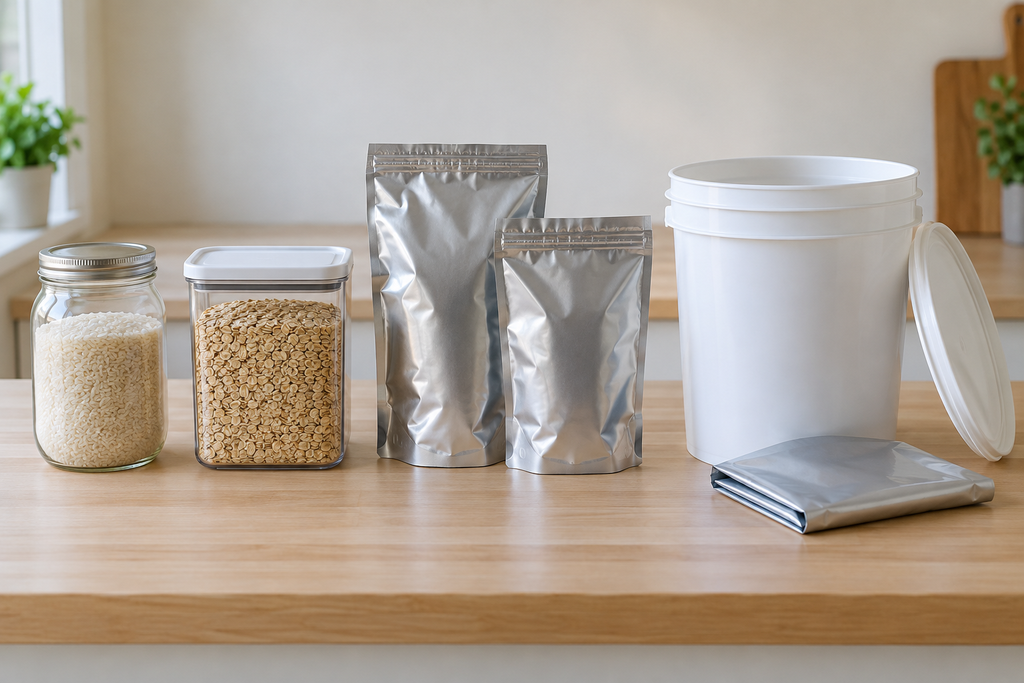
| Container type | Possible role | Important limitation |
|---|---|---|
| Glass jars with suitable lids | Smaller quantities of appropriate dry foods | Breakable and usually transparent |
| Food-contact plastic pantry containers | Frequently accessed ingredients | Barrier performance and closure quality vary |
| Food-grade buckets | Bulk handling and protective outer storage | The bucket and lid may not provide the barrier a particular food needs |
| Foil-laminate storage pouches | Suitable dry reserve foods | Can be punctured and require an appropriate seal |
| Vacuum-sealer bags | Uses supported by the bag and appliance instructions | Vacuum sealing alone does not preserve perishable food |
| Original commercial packaging | Products intended to remain in their supplied packages | Storage and after-opening instructions still apply |
This comparison identifies possible uses. It does not assign a guaranteed shelf life to any container.
Glass Jars: Useful for Smaller Quantities
Glass jars let you see the contents and can make smaller pantry quantities easy to organize.
Choose clean, dry jars in sound condition, with suitable closures. Check the rim and lid rather than assuming any jar with a screw thread will close reliably.
Protect transparent jars from unnecessary light exposure. Store them where they are unlikely to fall or be struck by heavier containers.
Dry storage and canning are different uses
A jar suitable for holding dry ingredients is not automatically suitable for home canning.
For canning, follow tested instructions specifying appropriate jars, lids and processing equipment. Putting food in a canning jar and closing the lid does not itself constitute a preservation process.
Practical fit: Ingredients you use in manageable quantities and can store with appropriate protection.
Plastic Pantry Containers: Convenient for Regular Access
Plastic containers can be lightweight and easy to handle. Their usefulness depends on the intended application, material, closure and condition.
Check the manufacturer’s information for food-contact suitability and any restrictions. A recycling symbol alone does not establish suitability for every food, temperature or storage period.
Before buying several matching containers, try one.
Ask:
- Can you open and close it comfortably?
- Is the closure easy to inspect and clean?
- Does it fit the shelf without wasting space?
- Can you remove the food without spilling?
- Is the filled container manageable?
A container that photographs well but is awkward to use may make rotation harder.
Food-Grade Buckets: Think About the Complete Package
Buckets can help organize larger quantities or protect smaller packages from handling damage.
Before using a bucket for direct food contact, verify its intended use and previous contents. Avoid containers with unknown histories or those previously used for chemicals.
A liner does not make a contaminated bucket a sensible choice.
Why the lid matters
A bucket’s performance depends partly on its closure. Check the matching lid, gasket where present, manufacturer’s instructions and condition.
Do not assume all snap-on or screw-top lids provide identical protection.
Why a liner may matter
For some suitable dry foods, an appropriately sealed barrier pouch inside a bucket can serve a different purpose from the bucket itself. The pouch provides its specified barrier, while the bucket helps protect and organize it.
Choose the combination according to food-specific guidance. “Food-grade bucket” is not a universal description of long-term storage performance.
Practical fit: Manageable bulk quantities or protective outer storage for suitable packaged foods.
Mylar and Other Foil-Laminate Pouches
Products commonly called Mylar food-storage bags include different constructions. Verify that the actual pouch is intended for food storage and suits your application.
Foil-laminate packaging can limit exposure to moisture and oxygen, but the closure remains important.
Check:
- The material and intended use.
- The supplier’s sealing instructions.
- The equipment needed to make the seal.
- Protection from sharp contents and external damage.
- Package size and labeling.
A resealable zipper and a heat seal are different closure features. Follow the pouch manufacturer’s instructions rather than assuming the zipper supplies the intended long-term seal.
Our Mylar bags for food storage guide explains these choices in more detail.
Interested in traditional pantry foods as well as modern packaging? Explore The Lost Superfoods book. Evaluate its ideas separately from the technical requirements of safely preserving and packaging a particular food.
Vacuum Bags: Packaging Is Only One Step
Vacuum sealing removes air from a package. It does not automatically make the contents shelf-stable.
Utah State University Extension explains that foods requiring refrigeration or freezing before vacuum packaging still need the appropriate cold storage afterward.
For suitable dry foods, compare the bag’s intended use and barrier properties. A bag designed for one kitchen application should not automatically be treated as equivalent to a foil-laminate reserve pouch.
Follow the appliance and bag instructions, including any restrictions on foods, liquids and sealing conditions.
Oxygen Absorbers Are Not a Universal Addition
Oxygen absorbers serve a particular purpose in appropriate packaging. They are not a way to correct inadequate drying or make an unsuitable food safe.
Reduced-oxygen storage of moist foods can create serious hazards. Food-specific suitability must be established before choosing packets or package sizes.
Read our oxygen absorbers for food storage guide before using them.
Keep the decisions in order:
- Identify the food and its condition.
- Confirm that the storage approach is appropriate.
- Choose suitable packaging.
- Follow authoritative guidance and supplier instructions for any absorber use.
Do not begin with a packet and assume everything else becomes suitable.
Choose Package Sizes Around Actual Use
The largest container is not always the most practical.
Consider how much food you use between openings, how quickly you can use an opened package and how heavy it becomes when filled.
For example, a household that uses modest amounts of rice may prefer several reserve portions plus a smaller working container. This can simplify handling without requiring every package to be opened repeatedly.
Before committing to a size, test it with an ordinary shopping quantity.
| Question | What to consider |
|---|---|
| Can I lift it comfortably? | Filled weight, grip and shelf height |
| Can I finish the opened portion conveniently? | Household consumption and product instructions |
| Can I identify the contents? | Labels and retained product information |
| Can I inspect the closure? | Access, visibility and maintenance |
| Can I replace it consistently? | Availability and total packaging cost |
When Original Packaging Makes Sense
Repackaging should have a clear purpose.
Commercial products may already have packaging designed for their contents. Keeping an appropriate product in its original package also preserves preparation instructions, allergen information, lot identification and storage directions.
If you place an unopened package inside an outer container for organization, keep the original information accessible.
Do not open a well-packaged product simply to make the pantry look uniform.
Inspect Containers Before Filling Them
For a container intended for suitable dry food, check for damage, residue, persistent odors and closure problems. Follow its cleaning instructions and ensure it is completely dry before filling.
For packages already holding food, a damaged closure raises a different question: what happened to the contents?
Resealing does not erase exposure to moisture, contamination or unsuitable conditions.
Our guide to food storage seal failures explains how to approach packaging problems without assuming a new seal restores safety.
Packaging Still Needs a Suitable Location
Even well-chosen packaging needs appropriate storage conditions.
Keep the reserve where you can inspect it and follow the food’s temperature, moisture and light requirements. Avoid treating a thick container as protection against every environmental problem.
Use our food storage conditions guide to assess the location before expanding your supplies.
A Simple Container Selection Checklist
Before buying or filling a container, confirm:
- The food is suitable for the intended storage method.
- The material is appropriate for food contact.
- The container’s history is known.
- Its barrier and closure suit the application.
- Its size fits your household’s use.
- Cleaning and sealing instructions are available.
- Labels retain important product details.
- The storage location is appropriate.
- You have a plan for opening, using and replacing the contents.
Choose one workable setup first. You can standardize more of the pantry after testing it.
Choose Packaging That Supports the Food
Good food storage begins with the ingredient and its requirements.
Use convenient containers for regular access, suitable reserve packaging where needed and manageable portions that fit your routine. Inspect closures and keep important instructions with the food.
The result should be easier to use and maintain—not simply more tightly packed.
For further reading on traditional food ideas, view the current The Lost Superfoods offer. Check the contents and terms, and verify preservation procedures before putting them into practice.